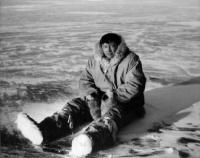
Lieutenant-Commander James Croal
Inducted In
1999
James (Hamish) Patrick Croal was born in Galt (Cambridge) and educated in Scotland. He joined the Merchant Marine before the start of WWII, enlisted as an Ordinary Seaman and earned his commission in 1944.
Following the War, Croal pushed back Canada’s Arctic frontiers. He was appointed Naval Observer for Exercise Muskox, the Canadian Army’s cold weather training project. As a civilian with the Defence Research Board in Churchill, Manitoba, he studied ice conditions, behaviour of vehicles and appropriate clothing and rations for military and scientific personnel operating in the Arctic. In 1948 he was a Canadian observer on American led expeditions to the Arctic when drilling tests were done for the construction of the Distant Early Warning (DEW) Line radar sites. This work resulted in Croal receiving a personnel commendation from the United States of America Secretary of the Navy.
In 1949, Croal joined the permanent force of the Royal Canadian Navy and was assigned to test survival equipment north of Churchill. He was on HMCS Labrador in 1954 when it became the first Canadian icebreaker to sail through the Northwest Passage, subsequently circumnavigating North America via the Panama Canal. He trained Canadian Army instructors in survival techniques and was a Defence Research Board consultant in a 1959 study of sea ice. In retirement Croal continued to work for the Defence Research Board in Ottawa, was a consultant to the Department of the Environment and to the Arctic Institute of Canada to which he was inducted as a Fellow.