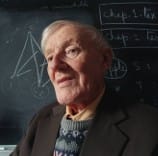
William “Bill” Tutte
Inducted In
2016
Bill Tutte was born in Newmarket, England at Fitzroy House, a horse racing stable. His father was the House gardener, his mother the housekeeper. When Tutte was eleven, he won a scholarship that enabled him to study in a high school in the City of Cambridge. There he excelled, particularly in mathematics, sciences and history; upon graduation, he was granted admission to Trinity College, Cambridge University.
At Trinity College, Tutte majored in the Natural Sciences, with a specialty in Chemistry; after three years, he achieved a First Class Degree. He continued on as a graduate student in Chemistry.
During the Second World War, Tutte was invited to become a part of the highly secret codebreaking organization, now known by its location, Bletchley Park. Tutte arrived in the spring of 1941 and was made a member of the Research Section, whose responsibility were codes that had not been broken.
In October, 1941 Tutte was presented with a sample of teletype tape, intercepted by radio antennae, produced by a machine that the British called Fish. This code was used by the Germans to communicate with Generals in field command. Tutte’s first great codebreaking contribution was to determine, from this sample of tape, the structure of the machine that produced the tape. His second great contribution was to describe how to decipher codes that this machine produced. Tutte’s method required a high speed electronic computer to carry out that decipherment. The computer which the British then developed was called Colossus. All contributions relative to Fish and Colossus were kept secret for more than 50 years.
After the War, Tutte returned to Cambridge as a PhD student in Mathematics. In 1948, Tutte was offered a position on the Faculty of the University of Toronto. In 1962 he accepted an offer from the University of Waterloo; he was instrumental in the development of the University, in particular the creation of its Faculty of Mathematics.
In the late 1990s, the veil of secrecy surrounding his war contributions was finally lifted. Tutte was named an Officer of the Order of Canada in 2001, for his breaking of Fish during the war and for his central contributions to combinatorial mathematics. In April 24, 2025, the UK Royal Mail issued a postage Stamp in the Royal Mail VE80 series recognizing Tutte’s contribution in deciphering the Lorenz cipher at Bletchley Park during WWII.
Photograph courtesy of the Waterloo Region Record/Mathew McCarthy.